This week, we engaged and particpated in lecture related to the use of LLM’s in education. We thought about how the rapid growth of this technology is impacting learners, educators, and learning environments. Since artifical intelligence is relatively new, we are learning that there are numerous benefits and downfaults that have arose. Overall, AI is changing the way that courses are created, espsecially in online education.
For this weeks reflection, I decided to think about the prompts that we brainstormed and collectively answered within breakout rooms during class. I have outlined my thoughts below.
First of all, at the start of class we talked about what LLM’s actually are. LLM stands for Large Language Model. This technology responds to prompts provided by users, and generates an outcome based on processing information from a variety of sources. Based on the information, an LLM can summarize, shorten, and create answers based on the average of all related findings (for example: websites, photos, blogs, or anything else available online). LLM’s are related to neural networks, although they are text focused (normally).
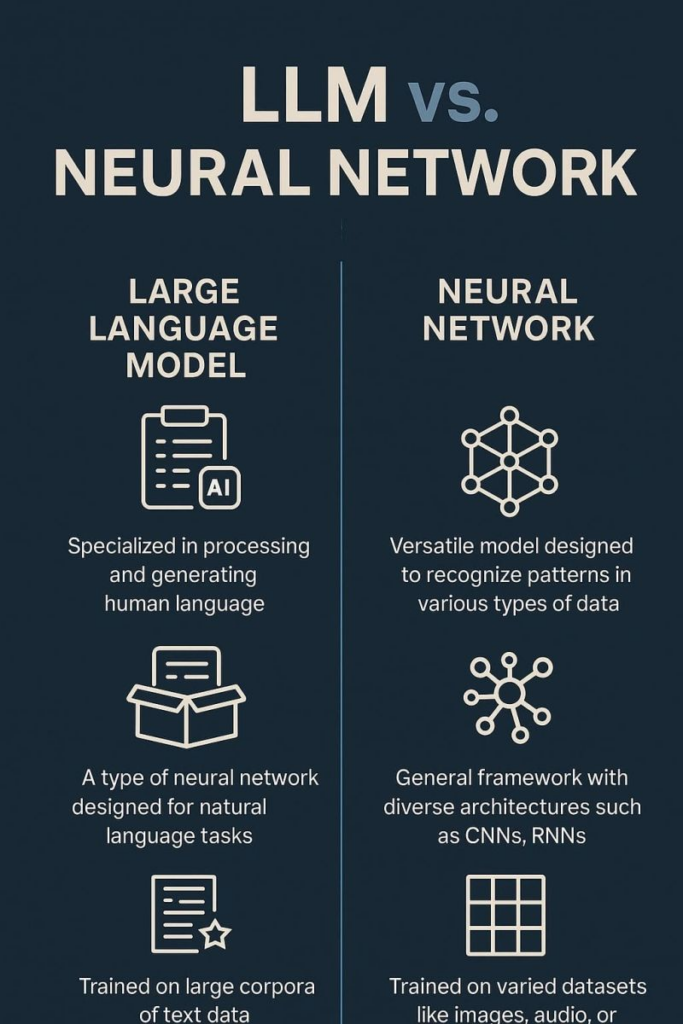
In class, we discussed questions of interest based on our experiences with LLMs within educational settings.
What has been the impact of LLMs on YOUR experience?
Personally, I have found AI to be incredibly helpful with the completion of tasks that are tedious. Specifically, I have used LLMs for things like summarizing notes, creating practice tests, and making me study guides. These are things that would have taken me a significant amount of time, but with AI, I can almost instantly gain access to these personalized resources by simply uploading my notes.
I have also used LLMs for some creative/visual endeavors. For instance, in EDCI 337, I used ChatGPT to create a simple graph. LLMs can be powerful tools in the creation of visual elements. I found it incredibly easy to use, and it sufficiently produced a graph that was simple and visually appealing.
What have been the policies in your classes?
Especially in my program, Health Informatics, some professors have been entirely open to the use of Generative AI within classroom settings. Since AI in healthcare is a topic that is popular, the field of health informatics is changing to utilize this technology to improve healthcare.
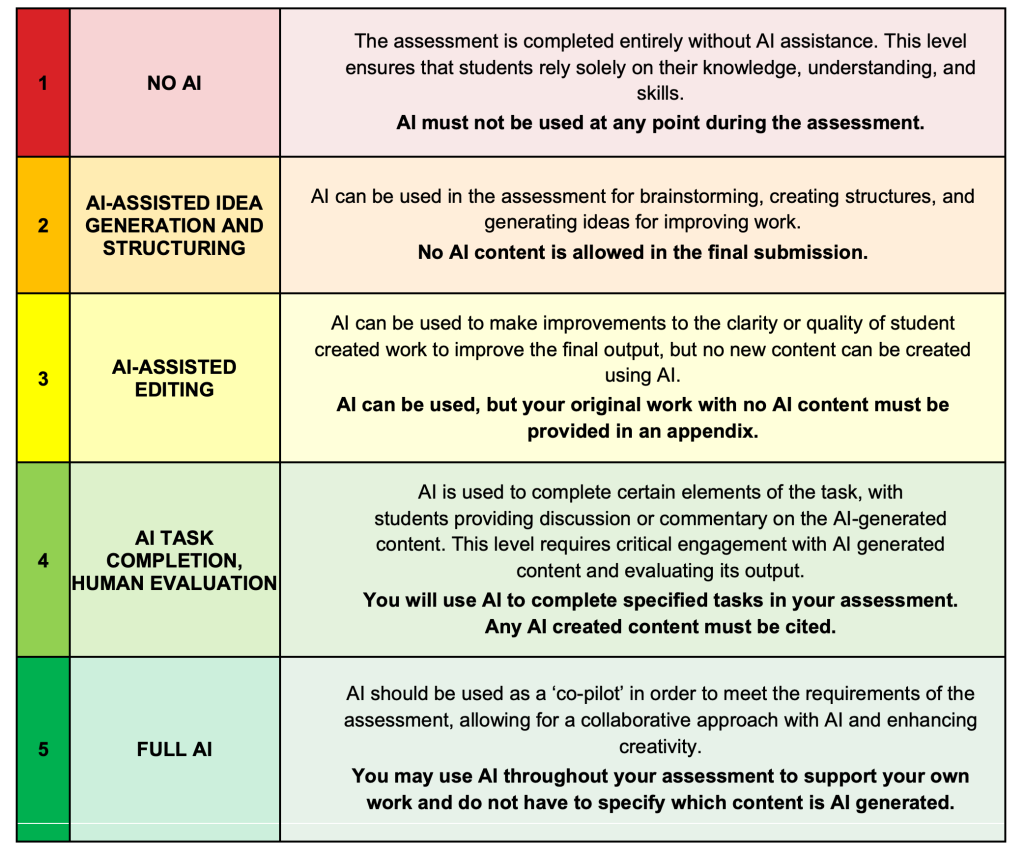
Knowing this, I have noticed that some of my professors are much more eager to use LLMs to support learning. In the grand scheme of all my classes though, I have noticed that the AI policy differs in each class at UVic. This can be confusing, as guidelines for each course can vary. Below is a diagram that was presented in one of my classes in the context of writing. Tools such as this explicitly outline how AI can be used, and I think that this could be a helpful tool for educators in stating what is allowed. This can support learners so they are clear on the usage of AI within the course.
How have those policies impacted your approach to learning?
In my approach to learning, the use of AI (when allowed in courses) has been really helpful as a study tool. I really like using LLMs when studying to support active recall methods, rather than passively. Using it in this format has been supportive of my learning, as long as I critically analyze it’s creations to make sure it remains accurate. Making sure I do my own reading/learning/notetaking to understand content is crucial.
Course learning outcome connections
Firstly, I think that the use of LLMs in education relates to the learning outcome: “Familiarity with ethical and legal frameworks around online and open education, including privacy legislation, copyright and Creative Commons licensing.” This is because AI can be used incorrectly in educational settings, leading us to ask if the use of AI in learning is moral/ethical.
Another outcome related to this conversation is: “Develop proficiency with software and tools useful in the teaching and learning process across different modes.” When used as a tool to support learning and teaching, AI can be beneficial. We discussed how AI can be helpful to those who are are proficient with using the technology, and can critically evaluate outputs.
Leave a Reply